"Just as poorly designed urban environments are associated with social disorders, so carefully designed places can uplift and improve the health and well being of individuals and communities." - Jan Semenza, Portland State University [1]Why do we need shelters? They shield us from the elements. They give us certainty in our lives in the form of a home, a place to return. Why do we need communities? They provide us with a sense of belonging, a sense of our value to the world. But what happens when people lose their homes, when they become detached from the very community they came from? I’m talking about the homeless. We often forget that people are homeless by circumstance. We complain when they smell bad and sleep in parks, but they don’t really have a choice. And when we associate all homeless with drunks and criminals, we take away their integrity as fellow human beings.
Recently I came across an interesting movement by homeless people for homeless people: the creation of their very own community to reclaim their dignity. Dignity Village began in 2000 as a small group of homeless citizens from Portland, Oregon illegally camping on public land. As the members increased, the Portland City Council agreed to let them stay in a city lot called the Sunderland Yard by designating it as a campground.

The original settlers [3]
In order to gain credibility with the citizens of Portland, the people of Dignity Village knew they could not rely on them. They had to be self-sufficient. The villagers devised a plan including building codes and infrastructure concepts to maximize the safety and sustainability of their community.

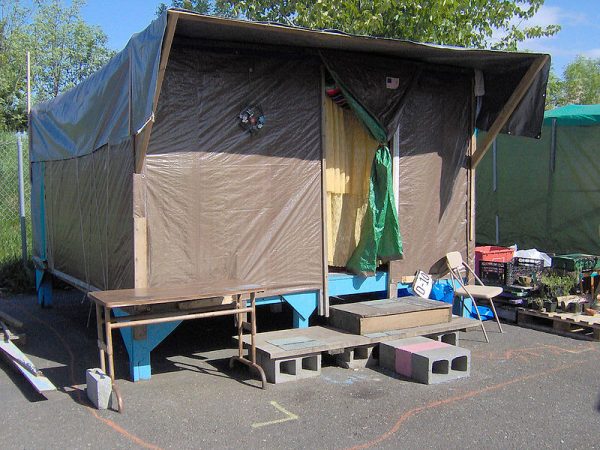
The houses of Dignity, temporary and permanent, are all built by village residents. Composed of recycled and natural materials, the 10’ x 10’ abodes are raised on platforms to minimize site damage and can be easily disassembled in case of relocation. Many new structures are built from cob, a cheap, natural building material consisting of clay, sand, straw, and water. Fireproof, waterproof, resilient to seismic activity, insulating, and simple to use, it is the perfect material for the location and its users.
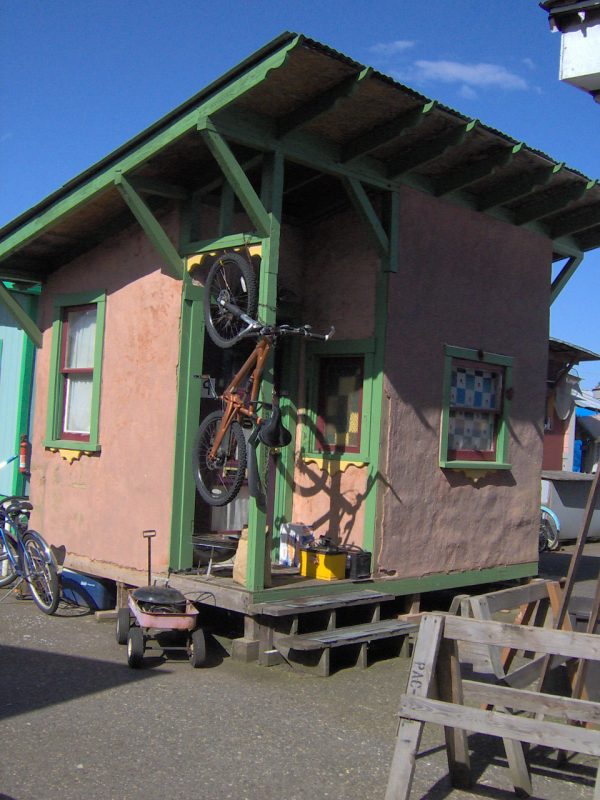
A permanent cob house in Dignity [6]
But a community cannot thrive unless it meets its basic needs. What keeps Dignity from degenerating into another slum is its simple and effective infrastructure: the availability of clean water and waste disposal. Making use of the Portland climate, all structures in the village are equipped with rain barrels that store water for fire suppression and irrigation of the produce gardens. With carbon filtering and solar (UV) disinfection, the rest of the water is acceptable for cleaning and consumption. Waste water is led out of the site with a man-made stream constructed from sand and pond-liner. Community composting toilets store solid human waste, creating compost material for the gardens.

A composting toilet [7]
Each of Dignity Village’s 65 inhabitants is a contributing member to the building, maintenance, and planning of the self-governing settlement. In their participation and engagement to their community, they are regaining their dignities and rebuilding their lives.

The village residents [8]
The accomplishment of self-sufficiency is a goal many cities can only dream of. Perhaps it is so difficult because we have overcomplicated our lifestyles with excesses. The adoption of Dignity Village's concept isn’t feasible in a society where ipods and cellphones are an individual’s essential items. The drive to survive just hasn’t registered yet. We haven’t experienced homelessness. Maybe, in order to truly understand what we really need, we need to have nothing first.
Media References:
1. Dignity Village, "Dignity Village Proposal", Dignity Village. 2004,
http://www.dignityvillage.org/proposal2003/index.html (accessed November 3, 2009)
2. TED Conferences, "Becky Blanton: The year I was homeless", TED Talks, October 2009,
http://www.ted.com/talks/becky_blanton_the_year_i_was_homeless.html (accessed November 3, 2009)
3. Dignity Village, "Dignity: PHOTOS", Dignity Village, 2004,
http://www.dignityvillage.org/photos/early-hf.jpg (accessed November 3, 2009)
4. Dignity Village, "Dignity: PHOTOS", Dignity Village, 2004,
http://www.dignityvillage.org/photos/520/520-8.jpg (accessed November 3, 2009)
http://www.tinyhousedesign.com/wp-content/uploads/2009/10/Dignity-Village-home-600x450.jpg (accessed November 3, 2009)
6. Michael Janzen, "Dignity Village: A Success Story", Tiny House Design, October 10, 2009,
http://www.tinyhousedesign.com/wp-content/uploads/2009/10/Dignity-Village-cabin-600x800.jpg (accessed November 3, 2009)
7. Dignity Village, "Dignity: PHOTOS", Dignity Village, 2004,
http://www.dignityvillage.org/photos/digsville/ToiletSeatSm.jpg (accessed November 3, 2009)
8. Dignity Village, "Dignity: PHOTOS", Dignity Village, 2004,
Information Sources:
Bayer, Israel. "From Doorways to Dignity". Street News Service. October 24, 2003.
http://www.streetnewsservice.org/index.php?page=archive_detail&articleID=182 (accessed November 3, 2009)
Cob Cottage Company. "What is Cob". Cob Cottage Company. 2009.
Dignity Village. "Dignity Village Proposal". Dignity Village. 2004.
http://www.dignityvillage.org/proposal2003/index.html (accessed November 3, 2009)
TED Conferences. "Becky Blanton: The year I was homeless". TED Talks, October 2009.

It's true, people do just take away the homeless' dignity as human beings, so good job to them for making themselves known and creating their own self-supporting village.
ReplyDeleteVery informative blog!
This is crazy, how did they come up with the idea, what prompted them to do this and what fueled their desire to not just be another "homeless person"? Obviously, none of them like being homeless but I wonder how they came up with the idea and why it became credited? This just blows my mind, other homeless in large communities should bind together like this to bring some life back to their souls.
ReplyDeleteI'm not too sure but I think the idea of having a home and community to return gives people certainty that they are human. The homeless are at the bottom of society and have often been mistreated. A place where they are allowed to live with dignity again seems like a really good idea.
ReplyDeleteIf you visit the Tent Cities Toolkit link I posted at the end of my post, the residents actually teamed up with a film crew to document the making of their village so they could inspire other people to do the same!
Damn Polly your becoming famous, this blog is reaching people. We are making a difference. Whoop!
ReplyDelete