Showing posts with label waste water treatment. Show all posts

Wednesday, November 4, 2009

SODIS: Clean Water in Kibera - Polly Auyeung

Water is important to all our lives. We use it for hydration and sanitization: two of our most basic health needs. Living in the developed world with our high-tech treatment systems, we are lucky to have clean water in the comfort of our own homes. But what about in the slums? What happens when there is no sewage treatment, no garbage disposal, and no running water?

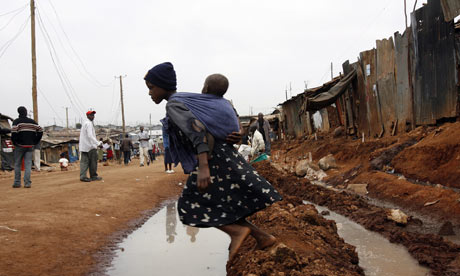
Kibera is one of the biggest slums in the world. A sprawling shantytown located in the southwest of Kenya's capital Nairobi, it is home to a million inhabitants making less than a dollar a day. During the rainy season, waters flood the open sewers causing human waste and garbage to overflow the area.

The streets of Kibera [1]

Outside of the city limits, Kibera does not have proper infrastructure and its inhabitants must rely on illegal means of acquiring water. Many private vendors buy water from the Nairobi Water Company at $0.02 a litre. Some even pirate the water through illegal pipelines. But due to the lack of resources in the area, the vendors are able to sell water at 125 times the regular price, at $2.50 a litre. For many of the residents, that price is too much to ask for. They resort to the contaminated streams flowing along the streets.

Open sewers [2]

But some of the people of Kibera have formed communities and organizations to become independent from the vendors and their price-fixing, to become self-sufficient. One of these organizations is the Kenya Water for Health Organisation (KWAHO), an advocate for cheap, safe, and legal water for all. Knowing that the women of the household were responsible for the distribution of water, they decided to start up women's collectives.

The women of the household are key to the family's well-being [3]

Starting in 2003, women formed community groups to buy water from the Nairobi Water Company. Together the residents built a sturdy pipeline from the water main on the outskirts of town and joined it to a storage tank near their homes. As word spread between families, more tanks were set up and the pipelines grew to join each other. However, in the chaos of a slum environment, it was difficult to ensure that water would not become contaminated.

Women managing the community tank [4]

The organization then introduced the women to SODIS, solar water disinfection. They noticed that many of the slum houses had corrugated metal rooftops whose shapes could keep round objects in place. Making use of the power of the Kenyan sun, the residents filled plastic bottles with water and lodged them on the rooftops for six hours. The ultra-violet rays coupled with the heat conducted by the metal disinfected the liquid. After a few tests, it was proven that this method was not only cheap and easy, but also just as effective as chemical treatment and boiling.

Placing bottles on the roof [5]

It is interesting to see once again, how people become the most resourceful when they are pushed to the limits of subsitent existence. In this case, the people of Kibera made use of the hot, sunny climate and the forms of their shantyhouses to make an effective clean, water storage system.

SODIS: storage and sanitization [6]

Media References:
1. International Federation of Surveyors, "FIG strengthens its role in co-operation with the UN-Habitat on tenure issues",International Federation of Surveyors, April 20, 2007,

2. Kingdom Geography Blog, "Kenya's slums attract poverty tourism", Kingdom Geography Blog, September 26, 2009,

3. Sarah Stuteville, "Kenyans tap sun to make dirty water sparkle", The CLP, April 13, 2008,

4. IRIN News, "Kenya: Kibera, the forgotten city", UN Office for the Coordination of Humanitarian Affairs, Sept. 13, 2006,

5. Solar Cooking International, "July 2005", Solar Cooker Review, July 2005,

6. Sarah Stuteville, "Kenyans tap sun to make dirty water sparkle", The CLP, April 13, 2008,

Information Sources:
IRIN News. "Kenya: Kibera, the forgotten city". UN Office for the Coordination of Humanitarian Affairs. Sept. 13, 2006.

Kenya Water for Health Organization. "SODIS Project." Kenya Water for Health Organization. May 20, 2008.
http://www.kwaho.org/pd-sodis.html (accessed November 4, 2009)

Stuteville, Sarah. "Kenyans tap sun to make dirty water sparkle." The CLP. April 13, 2008.

The Slum City - Expanding the Urban Fabric - by Suhaib Bhatti


Dhavari slum in Mumbai, India


Almost half the world — over three billion people — live on less than $2.50 a day.

At least 80% of humanity lives on less than $10 a day.

The poorest 40 percent of the world’s population accounts for 5 percent of global income.

The richest 20 percent accounts for three-quarters of world income.

25,000 children die each day due to poverty.

About 0.13% of the world’s population controlled 25% of the world’s financial assets in 2004.

The wealthiest nation on Earth has the widest gap between rich and poor of any industrialized nation.

Approximately half the world’s population now live in cities and towns.

1 in 3 urban dwellers live in slum conditions.


Urbanization is not synonymous with human progress. Urban slum growth is outpacing urban growth by a wide margin. [1]


The Questions


We know that the problem of poverty is an unresolved global issue, and the fact of urbanization is a puzzle in need of a solution. The presence of poverty, and a growing urban fabric inevitably leads to an increase in the urban poor. We are therefore required to face an interesting conundrum: how do we design an extension to our urban infrastructure to accommodate the growing urban population, and cater namely to the poor? How do we resolve the current issues of poverty while implementing such an infrastructure? What are the bare necessities for such an environment? How do we implement them in innovative methods to battle the issue of overusing our resources?


The Answers


The answer seems to be to develop existing slums to create ideal urban plans. In doing so, it is necessary to maintain an idea of what problems exist in slums, and what needs to be done to solve them, and to remember that any infrastructure implemented in a slum not only has to be affordable for those inhabiting it but by nature must also be resourceful for those implementing it.


Shelter

"For the 1.9 billion children from the developing world, 1 in 3 are without adequate shelter" [1]


In analyzing the concept of shelters in slum towns many problems are quite apparent. A major issue is the idea of land tenure and slum planning. In the majority of cases, slum inhabitants have no property rights and therefore no security of their property. Farouk Tebbal of UN-HABITAT presents a solution for this:


" To reach the target, new innovative tenure types will need to be developed which are affordable to the urban poor. Affordable, user friendly and transparent land administration and land management systems will have to be developed for city wide slum application. Slum areas that are not titled challenge existing land registration and cadastral approaches. In the slums there are little spatial information and the land use does not often fit the town plans. The land industry needs to think beyond conventional titling approaches as these will not be able to deliver fast enough or at a suitable scale and as they are generally not affordable to slum dwellers...we need to adapt the legal land regulatory framework and introduce innovative and affordable tenures and land information systems. The legal system such as property rights and security of tenure are critical to sustainable approaches to upgrading. Most residents of urban slums live without any form of secure tenure, under constant threat of eviction, which obviates their ability to access credit and constrains their motivation to improve their homes and neighbourhoods." [2]


Shelters themselves are of secondary concern since in most circumstances, they function affectively even if they do not meet our standards of living. In any case, many non-government organizations such as the Global Housing Foundation focus on the revitalization of slum buildings.


An example of the Global Housing Foundation's slum revitalization work.


Slums are affective investments in combatting the overuse of resources as the use of shelters made from entirely recycled materials is great for the environment. Ideas in green building have also been discussed in relation to slum development, mainly the idea of using geographic locations to the advantage of building. For example, highly agricultural areas could make use of straw-bale construction, whereas rammed earth, adobe, or 'earthship' shelters are extremely affective in desert climates. Hemp is also beginning to be use for its amazing strength as a panel. [3]


The planning of slums are also quite efficient. Slums need to be pedestrian friendly, as no system of public transportation exists within them nor are there vehicles. Slums are therefore designed to accommodate everything in one central community, from trade, to shelter, to healthcare. Everything of necessity, and even things of luxury, like restaurants, are accessible for those living in the slums.


Water Supply and Conservation


1 in 5 children in developing world have no access to safe water

1.4 million die each year from lack of access to safe drinking water and adequate sanitation

1.1 billion people in developing countries have inadequate access to water, and 2.6 billion lack basic sanitation.


1.8 billion people who have access to a water source within 1 kilometre, but not in their house or yard, consume around 20 litres per day. In the United Kingdom the average person uses more than 50 litres of water a day flushing toilets (where average daily water usage is about 150 liters a day. The highest average water use in the world is in the US, at 600 liters day.)

A mere 12% of the world’s population uses 85% of its water. [1]


The problem of water supply and conservation is of obvious concern. A recent collaboration between Queen's University in Kingston, Ontario and the Indian Institute of Technology has released a detailed study regarding the implementation of clean water systems in slums and the effectiveness of various technologies. Many treatment methods, such as boiling with fossil fuels, UV lamps, and chlorination have cheap annual costs and high effectiveness. [4]


Rainwater collection as a means for water supply is effective in areas with the right climate conditions and is a growing concern in shelter design to increase its effectiveness. The usefulness of such an idea in slum conditions is paramount because of its reliance not on third party water supply, but on nature itself, and its ability to be implemented as a cheap, resourceful, simple infrastructure solution. Implementing rainwater collection systems into shelter construction is inexpensive and effective in slum conditions.


Wet Waste Disposal


The implementation of personal toilets into individual households in slums is an ideal but greatly unrealistic proposition. Current slum conditions are horrid in regards to waste disposal. For example, in the Mathare 4A slum in Kenya only two public toilets were available for the 28 000 slum inhabitants, and in other slums conditions are so bad that residents must use 'flying toilets', or defecate in bags which are then thrown onto streets over the slum barriers. In fact children have been known to threaten city goers with balls of excrement in order to get money from them. This is because there is no place for the waste to go and a change is obviously needed. [5]


Current efforts by the Mumbai government towards the implementation of proper wet waste disposal consists of the building, planning, and management of community toilets. The forty million dollar project will provide 25% of India's slum population, or approximately 15.5 million peoplewith a proper sewage system. This is a great example of efficiently using resources to implement a new kind of infrastructure for the expanding urban fabric. [6]


Another technology being implemented in slums is the innovative use of odourless self-flushing toilets that make use of biosanitizer.


"An odorless self-flushing public toilet was constructed by the Green Cross Society in the premises of Versova Municipal Sewage Pumping Station, in Andheri(W), Mumbai 400 053. Here there is no water connection inside the toilets. People carry 1-2 liters of water for defecation, the thick sewage slurry gets treated in 2 horizontal shallow reactors using the BIOSANITIZER and planted filter. Clean water produced is pumped to the overhead tank that feeds the continuous flushing system.

This public toilet has been serving a slum community of about 100 people over the past 8 months. It is a good demonstration of using natural methods of sewage treatment, aimed at producing flushing water in the process. There is no use of electricity for treatment, no production of sludge and CO2. There is no manpower requirement for operation, repairs or maintenance. Operation is without any odor, in fact the toilet has fresh smell of forest air. The toilet pan remains clean due to cleaning properties of the treated sewage. This water also has shown pest-repellent properties. This, effectively, is pest control without using poisons and the resource liquid is produced from human excreta and urine that otherwise can get wasted and pollute the environment." [7]


The Lessons


What this means for architects and designers is to realize a new rift in the design world, and city plan. We must plan resourcefully and learn to design for the barest conditions, the lowest common denominator, to cater to the poor, to expand the urban fabric, and to make use of resources as effectively as possible.


Poverty is an obvious problem and obstacle not only in terms of global issues but in the context of urbanization. There is a connection between poverty and the urban fabric, and it is necessary to address this in developing an extension to our urban framework that uses a fraction of the resources and maximizes its efficiency. The idea is that the slum towns are not only intelligently designed forms of an ideal urban extension, but they are in fact useful as building blocks for a new urban design.

- Suhaib Bhatti


Notes


1. Anup Shah, "Poverty Facts and Stats," Global Issues, March 22, 2009, http://www.globalissues.org/article/26/poverty-facts-and-stats (accessed November 1, 2009).


2. Farouk Tebbal, "Security of Land Tenure Today," Un-Habitat, June 13, 2003, http://www.unhabitat.org/downloads/docs/1523_43689_security%20of%20land%20and%20tenure%20today.pdf (accessed October 29, 2009).


3. "Buildings and Shelter," Sustainable Enterprises, April 18, 2002, http://www.sustainableenterprises.com/Community/shelter.htm (accessed October 30, 2009).


4. "Slum Water Treatment," Sciencedirect, November 15, 2009, http://www.sciencedirect.com/science%20_ob=ArticleURL&_udi=B6TFX-4XC50FY-22&_user=1067412&_coverDate=11%2F15%2F2009&_alid=1077852303&_rdoc=2&_fmt=high&_orig=search&_cdi

=5238&_docanchor=&view=c&_ct=4603&_acct=C000051246&_version=1&_urlVersion=0&_userid=1067412&md5

=e1f9b2caa2864dec5ab128229e1a698f (accessed October 30, 2009).


5. Mike Davis, "Planet of Slums," The Globalist, May 16, 2007, http://www.theglobalist.com/StoryId.aspx?StoryId=6135 (accessed October 28, 2009).


6. Rupa Chinai, "Mumbai Slum Dwellers' Sewage Project Goes

Nationwide," Bulletin of the World Health Organization, August 1, 2002, http://www.archidev.org/IMG/pdf/v80n8a15.pdf (accessed October 28, 2009).


7. Vag Shantharam Shenai, "Odorless Self-flushing Toilet for Slum

Sanitation," Waste to Health, November 26, 2005, http://www.wastetohealth.com/odorless_public_toilet.html (accessed November 1, 2009).


Dignity Village: A Model of Self-Sufficiency - Polly Auyeung

"Just as poorly designed urban environments are associated with social disorders, so carefully designed places can uplift and improve the health and well being of individuals and communities." - Jan Semenza, Portland State University [1]
Why do we need shelters? They shield us from the elements. They give us certainty in our lives in the form of a home, a place to return. Why do we need communities? They provide us with a sense of belonging, a sense of our value to the world. But what happens when people lose their homes, when they become detached from the very community they came from? I’m talking about the homeless. We often forget that people are homeless by circumstance. We complain when they smell bad and sleep in parks, but they don’t really have a choice. And when we associate all homeless with drunks and criminals, we take away their integrity as fellow human beings.

Becky Blanton's experience of becoming one of the working homeless [2]

Recently I came across an interesting movement by homeless people for homeless people: the creation of their very own community to reclaim their dignity. Dignity Village began in 2000 as a small group of homeless citizens from Portland, Oregon illegally camping on public land. As the members increased, the Portland City Council agreed to let them stay in a city lot called the Sunderland Yard by designating it as a campground.

The original settlers [3]

In order to gain credibility with the citizens of Portland, the people of Dignity Village knew they could not rely on them. They had to be self-sufficient. The villagers devised a plan including building codes and infrastructure concepts to maximize the safety and sustainability of their community.

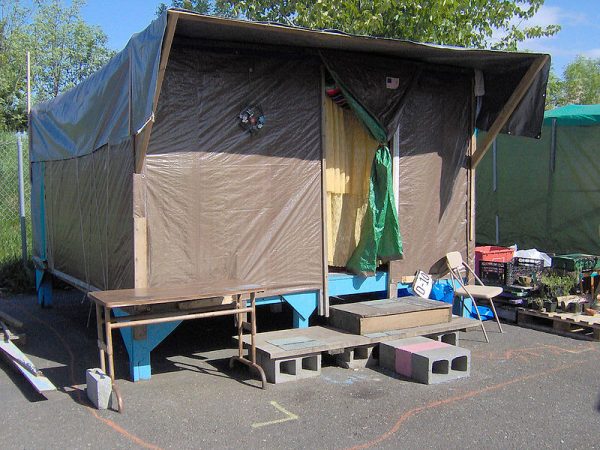
The early years [4]; temporary houses made of scavenged materials [5]

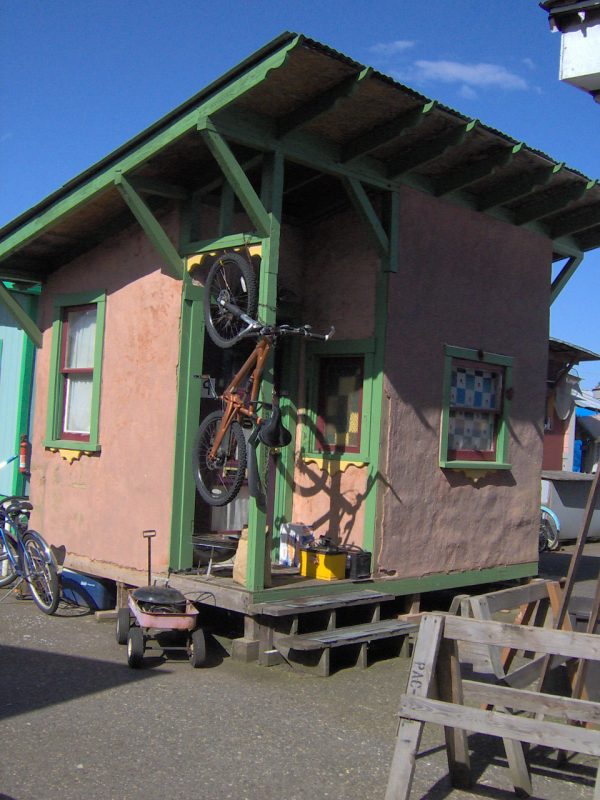
The houses of Dignity, temporary and permanent, are all built by village residents. Composed of recycled and natural materials, the 10’ x 10’ abodes are raised on platforms to minimize site damage and can be easily disassembled in case of relocation. Many new structures are built from cob, a cheap, natural building material consisting of clay, sand, straw, and water. Fireproof, waterproof, resilient to seismic activity, insulating, and simple to use, it is the perfect material for the location and its users.

A permanent cob house in Dignity [6]

But a community cannot thrive unless it meets its basic needs. What keeps Dignity from degenerating into another slum is its simple and effective infrastructure: the availability of clean water and waste disposal. Making use of the Portland climate, all structures in the village are equipped with rain barrels that store water for fire suppression and irrigation of the produce gardens. With carbon filtering and solar (UV) disinfection, the rest of the water is acceptable for cleaning and consumption. Waste water is led out of the site with a man-made stream constructed from sand and pond-liner. Community composting toilets store solid human waste, creating compost material for the gardens.

A composting toilet [7]

Each of Dignity Village’s 65 inhabitants is a contributing member to the building, maintenance, and planning of the self-governing settlement. In their participation and engagement to their community, they are regaining their dignities and rebuilding their lives.

The village residents [8]

The accomplishment of self-sufficiency is a goal many cities can only dream of. Perhaps it is so difficult because we have overcomplicated our lifestyles with excesses. The adoption of Dignity Village's concept isn’t feasible in a society where ipods and cellphones are an individual’s essential items. The drive to survive just hasn’t registered yet. We haven’t experienced homelessness. Maybe, in order to truly understand what we really need, we need to have nothing first.

Media References:
1. Dignity Village, "Dignity Village Proposal", Dignity Village. 2004,

2. TED Conferences, "Becky Blanton: The year I was homeless", TED Talks, October 2009,

3. Dignity Village, "Dignity: PHOTOS", Dignity Village, 2004,

4. Dignity Village, "Dignity: PHOTOS", Dignity Village, 2004,

5. Michael Janzen, "Dignity Village: A Success Story", Tiny House Design, October 10, 2009,

6. Michael Janzen, "Dignity Village: A Success Story", Tiny House Design, October 10, 2009,
7. Dignity Village, "Dignity: PHOTOS", Dignity Village, 2004,

8. Dignity Village, "Dignity: PHOTOS", Dignity Village, 2004,

Information Sources:
Bayer, Israel. "From Doorways to Dignity". Street News Service. October 24, 2003.

Cob Cottage Company. "What is Cob". Cob Cottage Company. 2009.
http://www.cobcottage.com/whatis (accessed November 3, 2009)

Dignity Village. "Dignity Village Proposal". Dignity Village. 2004.

TED Conferences. "Becky Blanton: The year I was homeless". TED Talks, October 2009.

Tuesday, November 3, 2009

cradle to cradle home - Giles Hall

CRADLE TO CRADLE design engages in a perpetually closed loop cycle. It strives to maintain materials in closed loops without damaging ecosystems. This is in direct contrast to cradle-to-grave production; materials dumped in landfills at the end of their life (2).


ENERGY is neither created nor destroyed; it is collected and returned. This design uses active solar collection to provide the main source of necessary electrical energy. It also shields unwanted summer sun and absorbs heat from low winter sun through its thermal mass. The vertical core is clad with a super-conductive photosynthetic plasma cell skin. It is able to generate twice the electrical voltage per area than contemporary photovoltaics. Using extracted spinach protein, this living skin is photosynthetic and phototropic it grows and follows the path of the sun, generating electricity in excess of a single family’s needs. Any excess power is distributed to neighboring homes and street lighting infrastructure (3).

WATER is crucial to life; it should be respected by future development. This building uses a vegetated roof system which collects and filters storm water into the building core. The core collects and redistributes all household plumbing. Black and grey water sent to a primary septic tank and eventually released as effluent to the "living garden" (*See Water Reuse Article). Gardens along the entry are irrigated and receive nutrients to yield vegetables. This system can also treat residential wastewater from neighboring homes (1).


See Water Reuse Standards Blog


MATERIALS should enable, not consume. The building’s primary insulator is Earth. It uses renewable soy-foam wall panels which have very high R-values and minimal embodied energy. Reconstituted concrete (with striated polymer mesh reinforcement) supports an open building plan, allowing for a flexible arrangement of partitions and spaces. This foresees the possibility of future users, with different space allocation needs.


VENTILATION
is fundamental to the comfort within any building. This building (designed for southern regions) forms and contours the wind while the roof overhang captures the breeze and directs it to the interior. The core acts as a ventilation tower, allowing a controllable flow of hot air up and out of the house by the positive pressure being created within the house. Shaded outdoor space provides another area of comfort.

COMMUNITY is essential to success; advances in residential building design and technology don’t matter if single families remain isolated and independent of one another. This design suggests that community interdependence is the necessary foundation for future growth. One home shelters one family, but creates a resource that benefits many. Excess energy is distributed to offset conventional power production while communal waste is retained on site, collected and treated to nurture common garden space. These shared resources are shared to link between individuals and a whole.

PICTURES (1)

WORK CITED
1. Matthew Coates, "Open Architecture Network," Cradle to Cradle (C2C) Home - Sustainable House of the Future, May 27 2007, http://www.openarchitecturenetwork.org/node/581 (accessed October 28, 2009).
2. McDonough Braungart Design Chemistry, "Transforming Industry; Cradle to Cradle," Eco-effectiveness: Nature's Design Patterns, 2009, http://www.mbdc.com/c2c_home.htm (accessed November 1, 2009)
3. "Coates Design," Coates Design Architectural Sustainability, 2007, http://www.cradletocradlehome.com/index.html (October 30, 2009)