Tuesday, November 24, 2009
Final Presentation Video
Untitled from stephanie Koltun on Vimeo.
Sound does not work. Will try to fix later. It works on Keynote tho.

Wednesday, November 4, 2009
SODIS: Clean Water in Kibera - Polly Auyeung
Water is important to all our lives. We use it for hydration and sanitization: two of our most basic health needs. Living in the developed world with our high-tech treatment systems, we are lucky to have clean water in the comfort of our own homes. But what about in the slums? What happens when there is no sewage treatment, no garbage disposal, and no running water?


The organization then introduced the women to SODIS, solar water disinfection. They noticed that many of the slum houses had corrugated metal rooftops whose shapes could keep round objects in place. Making use of the power of the Kenyan sun, the residents filled plastic bottles with water and lodged them on the rooftops for six hours. The ultra-violet rays coupled with the heat conducted by the metal disinfected the liquid. After a few tests, it was proven that this method was not only cheap and easy, but also just as effective as chemical treatment and boiling.


Kibera is one of the biggest slums in the world. A sprawling shantytown located in the southwest of Kenya's capital Nairobi, it is home to a million inhabitants making less than a dollar a day. During the rainy season, waters flood the open sewers causing human waste and garbage to overflow the area.

Outside of the city limits, Kibera does not have proper infrastructure and its inhabitants must rely on illegal means of acquiring water. Many private vendors buy water from the Nairobi Water Company at $0.02 a litre. Some even pirate the water through illegal pipelines. But due to the lack of resources in the area, the vendors are able to sell water at 125 times the regular price, at $2.50 a litre. For many of the residents, that price is too much to ask for. They resort to the contaminated streams flowing along the streets.
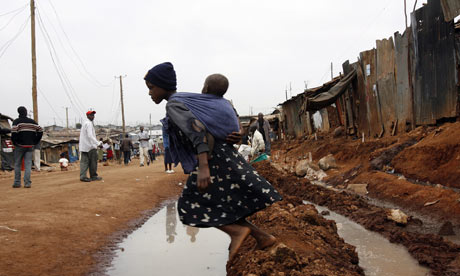
Open sewers [2]
But some of the people of Kibera have formed communities and organizations to become independent from the vendors and their price-fixing, to become self-sufficient. One of these organizations is the Kenya Water for Health Organisation (KWAHO), an advocate for cheap, safe, and legal water for all. Knowing that the women of the household were responsible for the distribution of water, they decided to start up women's collectives.

The women of the household are key to the family's well-being [3]
Starting in 2003, women formed community groups to buy water from the Nairobi Water Company. Together the residents built a sturdy pipeline from the water main on the outskirts of town and joined it to a storage tank near their homes. As word spread between families, more tanks were set up and the pipelines grew to join each other. However, in the chaos of a slum environment, it was difficult to ensure that water would not become contaminated.

Women managing the community tank [4]
The organization then introduced the women to SODIS, solar water disinfection. They noticed that many of the slum houses had corrugated metal rooftops whose shapes could keep round objects in place. Making use of the power of the Kenyan sun, the residents filled plastic bottles with water and lodged them on the rooftops for six hours. The ultra-violet rays coupled with the heat conducted by the metal disinfected the liquid. After a few tests, it was proven that this method was not only cheap and easy, but also just as effective as chemical treatment and boiling.

Placing bottles on the roof [5]
It is interesting to see once again, how people become the most resourceful when they are pushed to the limits of subsitent existence. In this case, the people of Kibera made use of the hot, sunny climate and the forms of their shantyhouses to make an effective clean, water storage system.

SODIS: storage and sanitization [6]
Media References:
1. International Federation of Surveyors, "FIG strengthens its role in co-operation with the UN-Habitat on tenure issues",International Federation of Surveyors, April 20, 2007,
http://www.fig.net/news/news_2007/nairobi_april_2007/kibera_6_600.jpg (accessed November 4, 2009)
2. Kingdom Geography Blog, "Kenya's slums attract poverty tourism", Kingdom Geography Blog, September 26, 2009,
http://static.guim.co.uk/sys-images/Guardian/Pix/pictures/2009/9/25/1253916635080/kibera-nairobi-002.jpg (accessed November 4, 2009)
3. Sarah Stuteville, "Kenyans tap sun to make dirty water sparkle", The CLP, April 13, 2008,
http://clpmag.org/content/images/2008/Kibera_Doorway.jpg (accessed November 4, 2009)
4. IRIN News, "Kenya: Kibera, the forgotten city", UN Office for the Coordination of Humanitarian Affairs, Sept. 13, 2006,
http://pictures.irinnews.org/images/2006926.jpg (accessed November 4, 2009)
5. Solar Cooking International, "July 2005", Solar Cooker Review, July 2005,
http://solarcooking.org/images/scr/jul05/photox_small.jpg (accessed November 4, 2009)
6. Sarah Stuteville, "Kenyans tap sun to make dirty water sparkle", The CLP, April 13, 2008,
Information Sources:
IRIN News. "Kenya: Kibera, the forgotten city". UN Office for the Coordination of Humanitarian Affairs. Sept. 13, 2006.
Kenya Water for Health Organization. "SODIS Project." Kenya Water for Health Organization. May 20, 2008.
Stuteville, Sarah. "Kenyans tap sun to make dirty water sparkle." The CLP. April 13, 2008.
http://clpmag.org/article.php?article=Kenyans-Tap-Sun-to-Make-Dirty-Water-Sparkle_029 (accessed November 4, 2009)
Subscribe to:
Posts (Atom)